For Early Modern food historians, one of the most important aspects of the discipline also proves to be the most difficult: uncovering everyday consumption practices. With few sources to reference, historians rely mainly on works such as cookbooks to gauge what people were consuming on a daily basis. However, these sources prove to be variable, as the owners of these works, as in our present day, may have used one recipe consistently while never even looking at another. Therefore, the kitchen record, A weekly book for London House, 1612 March 25 - 1614 March 25 (hereafter termed London House), is a crucial informant of previously intangible information regarding realistic consumption practices.
Documenting the foods purchased by houses on a weekly basis, kitchen records are rare yet vital sources as they provide one of the most accurate representations of Early Modern diets. However, as is the case with London House, they are often highly complex and difficult to read, making it virtually impossible for historians to gather any useful information.
The London House Project is an attempt to employ digital humanities to solve this problem. By gathering information from London House and employing data visualization tools to present the findings, this project seeks to increase the accessibility of this record, making it a viable source for food historians to employ in their research.
Additionally, The London House Project utilizes these findings to answer its own research questions. Specifically, how do actual, everyday consumption patterns compare to what the people of Early Modern England portrayed themselves as consuming? Is there a difference between their perceived diet and their actual eating practices?
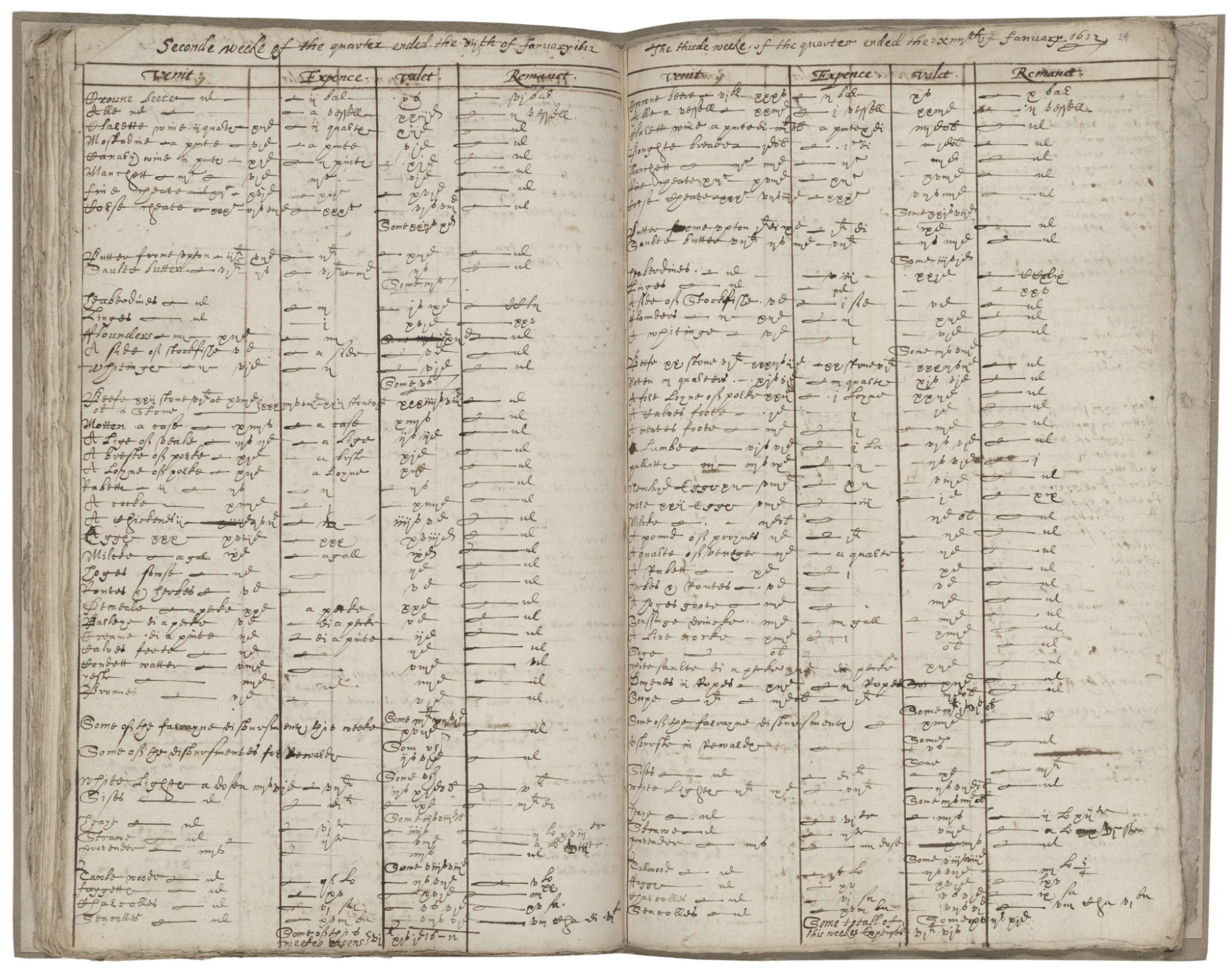 A photo of the first page of “London House” taken from the Folger Skakespeare Library