London House is a kitchen record dating from 1612 to 1614, currently held at The Folger Shakespeare Library in Washington, D.C. Given its location, the record was too far away to conduct in-person research within the time allotted. Fortunately, however, the Folger has created a high-quality digitized version of London House, which is currently maintained by the online archive “Beyond the Page.” While the goal is to see London House in person eventually, the digitized version of the work was consulted for this project.
Kitchen records are a very rare and specific form of archival material. These sources are perhaps most similar to an account book in that they track household expenses on a weekly basis. However, unlike most account books, a kitchen record focuses solely on the food purchased for the household each week. What makes this record particularly interesting is that it not only tracks the food purchased, but also what was consumed, the price, and what was left over for the coming weeks. This information was laid out in varying formats but had four consistent categories: “Venit,” the type of food purchased, “Expence,” how much of the food was consumed, “Valet,” the price to purchase the food item, and “Remanet,” the amount, if any, left over for the coming weeks.
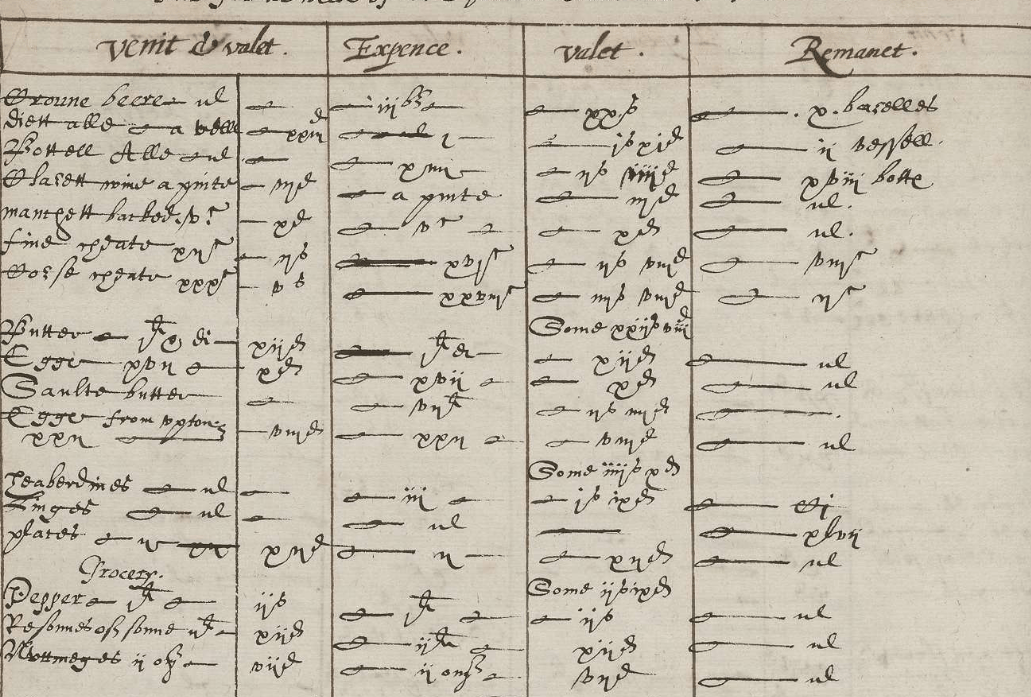 A photo of the categories of London House
An upclose image of the four categories listed in London House Such records are incredibly rare and, thus, highly valued amongst food historians. This is not only due to their scarcity but also because they provide crucial information about actualized, everyday consumption practices that cannot be consistently gleaned from other archival sources. Unfortunately, little is known about London House, including its exact location, its property, the estate’s owners, or the name of the record’s creator. All that is known, according to the Folger Shakespeare Library, is that “the householder was apparently a Lady, a friend of Lady Townshend and of Lord Stanhope, but her name is not mentioned.” Considering the work is titled London House, it is reasonable to assume that this was one of many properties the family owned. This is in keeping with the time, as it was very common in the Early Modern Period for wealthy families to maintain a country estate to which they retreated during the hotter months of the year. Although this is currently all speculation, finding out as much as possible about the owners of London House is a key goal for this project’s future. Hopefully, visiting this work in person at the Folger may provide some answers to this current mystery.